Peter Claver was born in Verdú, in present-day Spain, and spent a central part of his religious life in Cartagena. Ordained a priest in the city on March 19, 1616, he devoted his work to enslaved, sick and poor people in one of the ports of the colonial slave trade.
An arrival that unfolded in stages
Claver belonged to the Society of Jesus. He traveled to the Americas in 1610 and spent time in Santafé and Tunja before returning to Cartagena in 1615 to continue his path toward the priesthood.
Before the voyage he had entered the Jesuit novitiate in Tarragona in 1602. He later studied philosophy at the College of Montesión in Palma de Mallorca, where he received spiritual guidance from Alonso Rodríguez.
In Barcelona he studied theology from November 1608 until January 1610, when he received instructions to leave. He therefore did not arrive in the New Kingdom as an already ordained priest: in the Americas he completed the stages leading to his Cartagena ordination in 1616.
From Cartagena he continued inland along the Magdalena route and reached Santafé, where he served at the College of San Bartolomé. In 1614 he spent time in Tunja; the following year he began the return that opened his longest period in the port.
His 1616 ordination was preceded by two others: subdeacon in December 1615 and deacon the following February. He received them from Fray Pedro de la Vega. He was the first Jesuit ordained as a priest in Cartagena.
Religious assistance in a slave-trading port
The Cartagena he knew received ships carrying African people subjected to enslavement. The ships disembarked people destined to be sold and transferred elsewhere.
He also cared for sick and poor people, including those with leprosy at San Lázaro. Care thus extended beyond those disembarking from ships.
Material assistance took the form of everyday actions: washing wounds, finding food and accompanying people who were ill. Evangelization and baptisms belonged to the religious purpose of his ministry and took place in that same setting.
At the port, enslaved people were treated as merchandise within a system supplying other territories and activities, including mines. Claver’s work took place within that forced circulation, not after it had disappeared.
His dedication to people arriving at the port explains why Catholic memory associated him with the enslaved. That care did not itself restore their legal freedom: religious assistance and people’s legal status were different realities.
From religious recognition to a place of memory
In April 1622 his final vows confirmed his definitive membership in the Society of Jesus. The formula linking his name to serving enslaved Black people became associated with the way he wanted to define that mission.
The final stage of his life differed from his years of activity. He fell ill in 1650 and spent a prolonged period in poor health before dying in Cartagena in 1654.
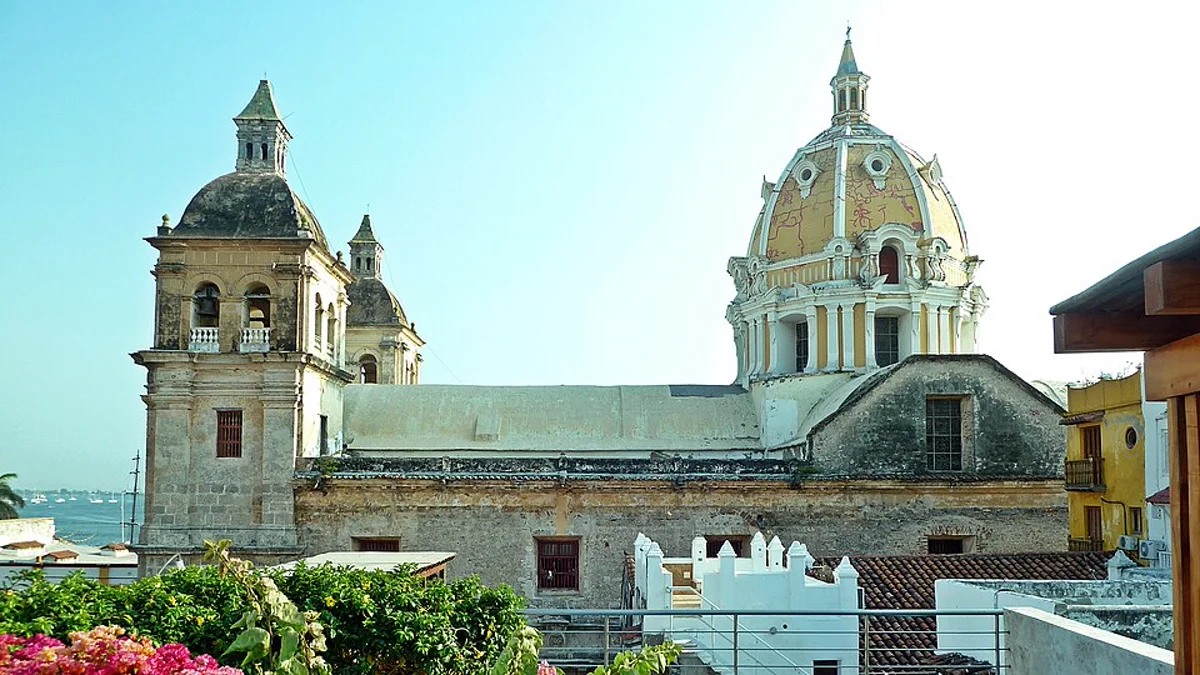
Ecclesiastical recognition came much later: Pius IX declared him blessed in 1850 and Leo XIII canonized him in 1888. Centuries separated his death from those acts; the church now bearing his name brings that religious memory together with the history of the place.
The port and the city of the Holy Office
Claver also lived in the Cartagena where the Inquisition tribunal, established in 1610, operated. During his residence, autos-da-fé and proceedings were held against people accused of departing from Catholic doctrine.
Those persecuted included Black men and women subjected to trials for alleged witchcraft in Cartagena, Tolú and Zaragoza. Religious persecution coexisted with the slave trade and with the forms of assistance practiced by the Jesuit.
The tribunal’s activity and Claver’s ministry unfolded during the same decades. The priest’s memory belongs to a city that was simultaneously a landing port, a commercial center and the seat of institutions of religious control.